🎉 Up to 70% Off Selected ItemsShop Sale
Common Grace
The first major poetry collection from an award-winning student of Robert Pinsky, exploring the inherited trauma within his Japanese American family, his life as an artist, and his bond with his wife
In 65 lyric poems organized into a triptych, Common Grace offers an important new lens into Asian American life, art, and love.
Part 1, “Soul Sauce,” describes the poet’s life as a practicing visual artist, taking us from an early encounter with an inkwell at Roseland Elementary in 1969 to his professional outdoor easel perched on Long Island Sound.
Part 2, ‘Ubasute,” is named after the mythical Japanese practice wherein “a grown son lifts / his aged mother on his back, / delivers her to a mountain, / leaves her to die.” This concept frames a wrenching portrayal of his parents’ decline and death, reaching back to his father’s time in the American internment camps of WWII and his mother’s memories of the firebombing of Tokyo. It also anchors the 2 outer parts in the racial trauma and joys passed down from his parents.
Part 3, “Gutter Trees,” gives us affecting love poems to his wife and the creative lives they’ve built together.
Ranging in scope from private moments to the sweep of familial heritage, Caycedo-Kimura’s poems are artful, subtle, but never quiet.
In 65 lyric poems organized into a triptych, Common Grace offers an important new lens into Asian American life, art, and love.
Part 1, “Soul Sauce,” describes the poet’s life as a practicing visual artist, taking us from an early encounter with an inkwell at Roseland Elementary in 1969 to his professional outdoor easel perched on Long Island Sound.
Part 2, ‘Ubasute,” is named after the mythical Japanese practice wherein “a grown son lifts / his aged mother on his back, / delivers her to a mountain, / leaves her to die.” This concept frames a wrenching portrayal of his parents’ decline and death, reaching back to his father’s time in the American internment camps of WWII and his mother’s memories of the firebombing of Tokyo. It also anchors the 2 outer parts in the racial trauma and joys passed down from his parents.
Part 3, “Gutter Trees,” gives us affecting love poems to his wife and the creative lives they’ve built together.
Ranging in scope from private moments to the sweep of familial heritage, Caycedo-Kimura’s poems are artful, subtle, but never quiet.
$6.39
Original: $18.25
-65%Common Grace—
$18.25
$6.39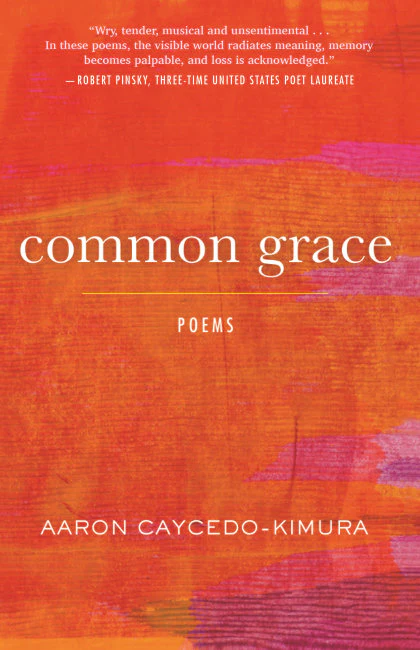
Description
The first major poetry collection from an award-winning student of Robert Pinsky, exploring the inherited trauma within his Japanese American family, his life as an artist, and his bond with his wife
In 65 lyric poems organized into a triptych, Common Grace offers an important new lens into Asian American life, art, and love.
Part 1, “Soul Sauce,” describes the poet’s life as a practicing visual artist, taking us from an early encounter with an inkwell at Roseland Elementary in 1969 to his professional outdoor easel perched on Long Island Sound.
Part 2, ‘Ubasute,” is named after the mythical Japanese practice wherein “a grown son lifts / his aged mother on his back, / delivers her to a mountain, / leaves her to die.” This concept frames a wrenching portrayal of his parents’ decline and death, reaching back to his father’s time in the American internment camps of WWII and his mother’s memories of the firebombing of Tokyo. It also anchors the 2 outer parts in the racial trauma and joys passed down from his parents.
Part 3, “Gutter Trees,” gives us affecting love poems to his wife and the creative lives they’ve built together.
Ranging in scope from private moments to the sweep of familial heritage, Caycedo-Kimura’s poems are artful, subtle, but never quiet.
In 65 lyric poems organized into a triptych, Common Grace offers an important new lens into Asian American life, art, and love.
Part 1, “Soul Sauce,” describes the poet’s life as a practicing visual artist, taking us from an early encounter with an inkwell at Roseland Elementary in 1969 to his professional outdoor easel perched on Long Island Sound.
Part 2, ‘Ubasute,” is named after the mythical Japanese practice wherein “a grown son lifts / his aged mother on his back, / delivers her to a mountain, / leaves her to die.” This concept frames a wrenching portrayal of his parents’ decline and death, reaching back to his father’s time in the American internment camps of WWII and his mother’s memories of the firebombing of Tokyo. It also anchors the 2 outer parts in the racial trauma and joys passed down from his parents.
Part 3, “Gutter Trees,” gives us affecting love poems to his wife and the creative lives they’ve built together.
Ranging in scope from private moments to the sweep of familial heritage, Caycedo-Kimura’s poems are artful, subtle, but never quiet.